My Wedding Photography Process
August 13, 2026
One of the questions I get asked fairly often is some version of:
“What is your process?”
And, for a long time, I never really knew how to answer it.
Not because there isn’t one. There absolutely is. It’s just that after photographing weddings across Oxfordshire and the Cotswolds for long enough, a lot of it stops feeling like a process and starts feeling instinctive.
I’m not turning up with a clipboard, a shot list and a plan to manufacture every part of the day. I’m also not standing silently in a corner hoping something interesting wanders into frame.
My approach sits somewhere between the two.
I photograph weddings in a documentary way, with an editorial eye. I want the photographs to feel observed rather than manufactured, but I’m also very aware of light, composition, colour, shape and timing.
And sometimes, yes, I’ll move you two feet to the left because the light is better there.
That is probably the simplest explanation.
Before the wedding
A large part of my work happens before I ever pick up a camera.
I want to understand how the day is actually going to work.
Where are you getting ready? Who matters most to you? Are there complicated family dynamics I should know about? Are you planning ten group photographs in a fifteen-minute window? Is there a beautiful bit of evening light available just as everyone is sitting down to eat?
The practical information matters because good documentary photography still requires planning.
The difference is that I’m trying to plan around the wedding, rather than turning the wedding into a photography schedule.
If something looks rushed, I’ll tell you.
If I think we can move the portraits somewhere quieter in the day, I’ll suggest it.
If you’ve accidentally allocated twelve minutes to confetti, twenty family photographs and portraits of the two of you, we’re probably going to have a conversation.
The aim is always the same: give the photography enough room to happen without making the photography the centre of the day.
On the day, I observe first
For most of a wedding, I’m watching.
Not just the obvious things.
I’m looking at the people around the edges.
The dad rehearsing his speech alone in a corridor.
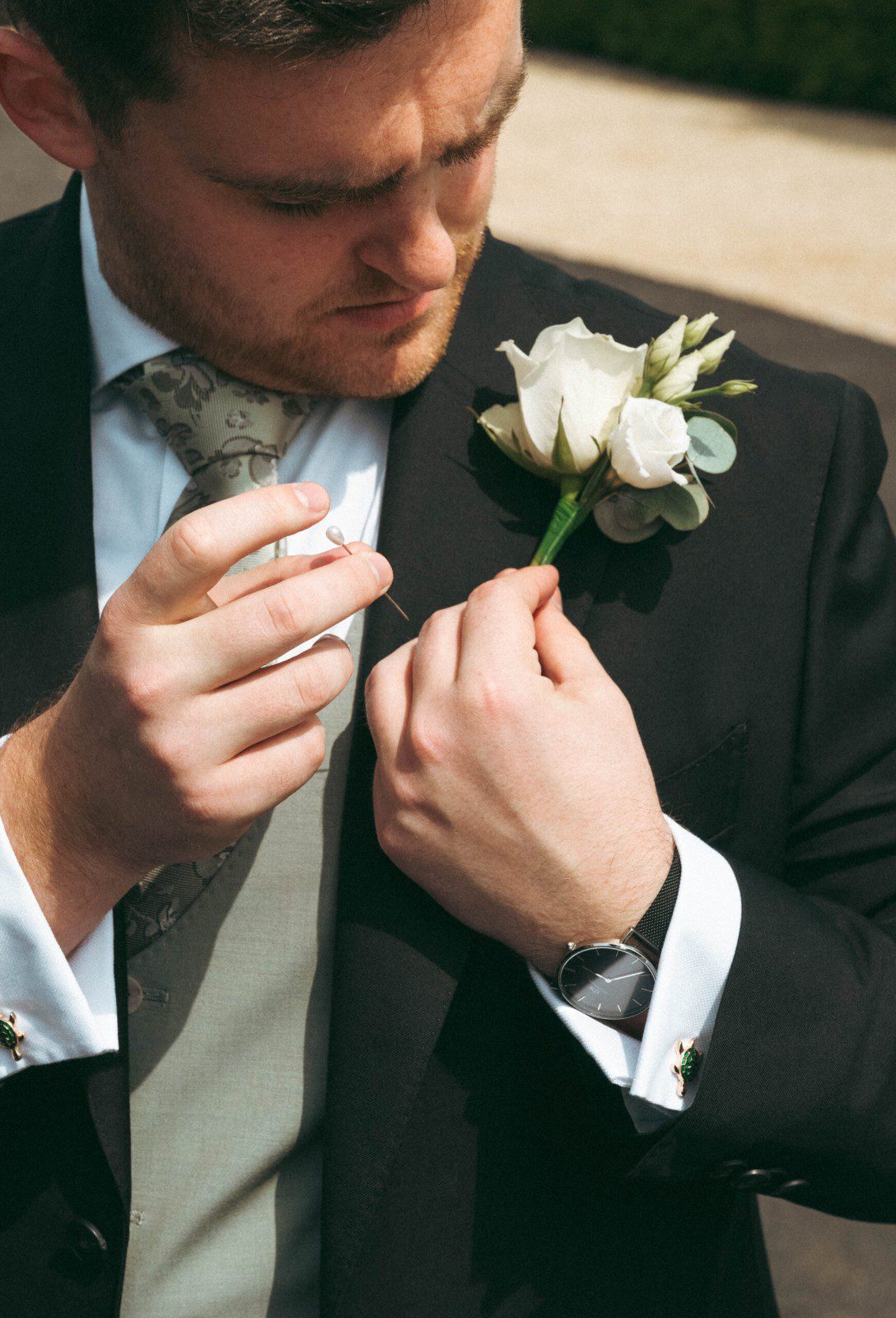
Someone repairing a buttonhole.
A grandmother watching the dance floor rather than being on it.
People disappearing outside for five minutes with a cigarette.
Children becoming increasingly feral as the evening goes on.
The friend who has cried approximately six times before the ceremony has even started.
Those photographs often end up being as important as the big moments.
Maybe more important.
Because weddings are not really a sequence of scheduled events. They’re hundreds of tiny interactions happening simultaneously.
My job is to notice them.
Documentary doesn’t mean invisible
There is sometimes an idea that documentary wedding photographers must never interfere with anything.
I don’t really subscribe to that.
I’m not going to stop a genuine moment because somebody happens to be standing in imperfect light.
But equally, if we’re making a portrait and moving you half a metre gives us something dramatically better, I’m going to move you.
If someone needs help with a buttonhole, I’ll help them.
If a room is chaotic and there’s one beautiful window, I might suggest we use it.
If we need to organise family photographs efficiently so everyone can get back to the champagne, I’ll organise them.
I don’t think being documentary means pretending the photographer isn’t there.
It means knowing when not to interfere.
That distinction matters.
Portraits without turning your wedding into a photoshoot
Couples portraits are probably where the editorial side of my work becomes most obvious.
But I still don’t want them to feel overly staged.
I’m much more interested in creating the right conditions for a photograph than manufacturing the emotion inside it.
That might mean finding interesting architecture, good light, a quiet street, an empty field or simply a wall that happens to be catching the sun beautifully.
I’ll give you enough direction that you don’t feel abandoned in front of a camera.
Then I’ll back off.
I’m not especially interested in asking people to repeatedly look at each other and laugh on command.
I’d rather compose the photograph, get the light right and allow whatever happens between you to happen naturally.
The editorial element comes from how I frame and see the scene.
The human bit should still belong to you.
Why I photograph some of the day on film
Film has become an increasingly important part of the way I photograph weddings.
Not because I want every photograph to look old.
And not because film has suddenly become fashionable again.
I just genuinely like what it does to photographs.
A roll of 35mm film gives me a limited number of frames. That changes the way I work.
I slow down.
I look a little longer.
I decide whether the photograph really needs to exist before I press the shutter.
Digital photography is incredibly good at reacting quickly. It gives me flexibility when things are moving fast and allows me to follow moments as they develop.
Film does almost the opposite.
It forces a decision.
So I tend to use it intentionally.
A portrait.
A particular quality of light.
A quiet moment.
Something slightly strange.
A photograph where I think the grain, colour and imperfection of film will actually add something.
I’m not trying to shoot identical frames on film and digital.
They’re two different ways of looking at the same day.
I’m editing long before I open Lightroom
A big part of photography is deciding what not to photograph.
Throughout a wedding I’m constantly asking myself:
Have I already made this picture?
Does this add anything?
Is something more interesting happening somewhere else?
Do I need another photograph of this, or have I already told this part of the story?
Modern cameras make it incredibly easy to produce thousands and thousands of technically competent photographs.
That doesn’t necessarily make the finished work better.
I’d rather make photographs deliberately.
That doesn’t mean I shoot slowly all day. Sometimes a moment unfolds and I’ll photograph continuously because I don’t know which tiny expression will be the important one.
But there should still be a reason for the frame.
The edit is part of the photography
Once the wedding is over, I don’t see the job as simply removing blinks and delivering everything else.
The editing process is where the photographs become a body of work.
I’m thinking about rhythm.
Big moments next to quiet ones.
Wide photographs that establish where we are.
Small details that would otherwise be forgotten.
Portraits.
Movement.
Humour.
Chaos.
Stillness.
There will often be two perfectly good photographs where only one needs to exist.
Choosing between them is part of the work.
The finished gallery should feel coherent without feeling repetitive.
It should have atmosphere.
Most importantly, it should feel like your wedding, rather than simply another wedding processed through the same preset.
I want the photographs to feel like memories
That is probably what all of this comes back to.
I’m not particularly interested in creating a flawless record of every object that appeared at a wedding.
I want the photographs to bring something back.
The weather.
The room.
The noise.
How somebody looked at you.
How your dad held himself just before walking you down the aisle.
The slightly ridiculous thing your friends were doing during dinner.
The five quiet minutes you had together before going back inside.
Years later, I want the photographs to feel less like evidence that the wedding happened and more like a way of briefly stepping back inside it.
So perhaps that is my process.
I observe first.
I intervene when it helps.
I pay attention to light and composition.
I use film when the moment deserves slowing down.
And then I edit everything together as one story.
The technical part matters, of course.
But ultimately, I’m just trying to make photographs that feel true to what it was like to be there.

Be the first to comment